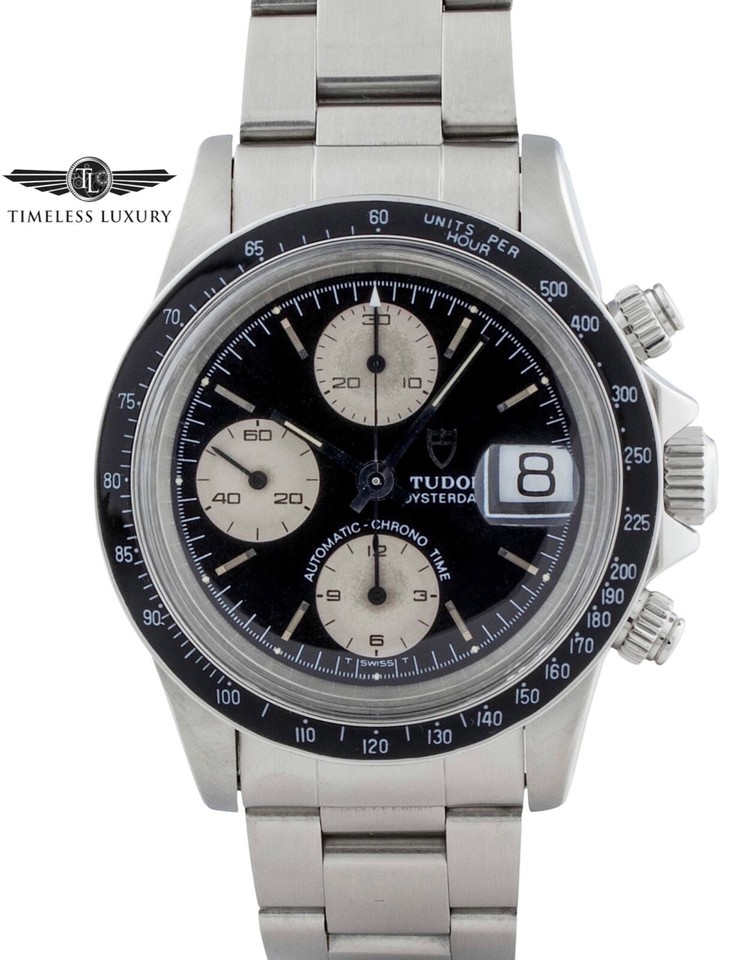
Big Block 79160
Tudor's first self-winding chronograph, named for its deep case
The 'Big Block' was Tudor's third chronograph series, launched in 1976 as the first self-winding chronograph from the Wilsdorf group (Rolex/Tudor) — over a decade before Rolex's first automatic Daytona. It is powered by a Tudor-modified Valjoux 7750 automatic movement with quick-set date. The nickname comes from the case, which had to be made unusually deep to house the self-winding movement's rotor.
The first generation used the 9400-series references (9420, 9421, 9430). In the late 1980s (Tudor dates it to 1989) the line moved to the 79100 series on the same case: reference 79160 carried a black plastic tachymeter bezel, alongside the 79170 (12-hour bidirectional bezel) and 79180 (steel tachymeter bezel). These were sold under the 'Prince Oysterdate' name and the series ran for nearly 20 years.
- The 'Big Block' nickname comes from the deep case required to fit the self-winding movement's rotor. ↗ revolutionwatch.com
- Powered by a Tudor-modified Valjoux 7750 automatic chronograph movement with quick-set date. ↗ revolutionwatch.com
- The first Big Blocks (1976) were the first self-winding chronographs from the Wilsdorf group, over a decade before Rolex's automatic Daytona. ↗ revolutionwatch.com
- Reference 79160 belongs to the 79100 series introduced c.1989 to replace the 9400 series; it wears a black plastic tachymeter bezel. ↗ tudorwatch.com
- Chunky chronograph; dealer references cite a case roughly 14.5mm tall. ↗ europeanwatch.com