Model
← Rolex
Milgauss 1019
Milgauss 1019: the 1,000-gauss antimagnetic Rolex
$875–$51,280 market range · 16 listed now
History
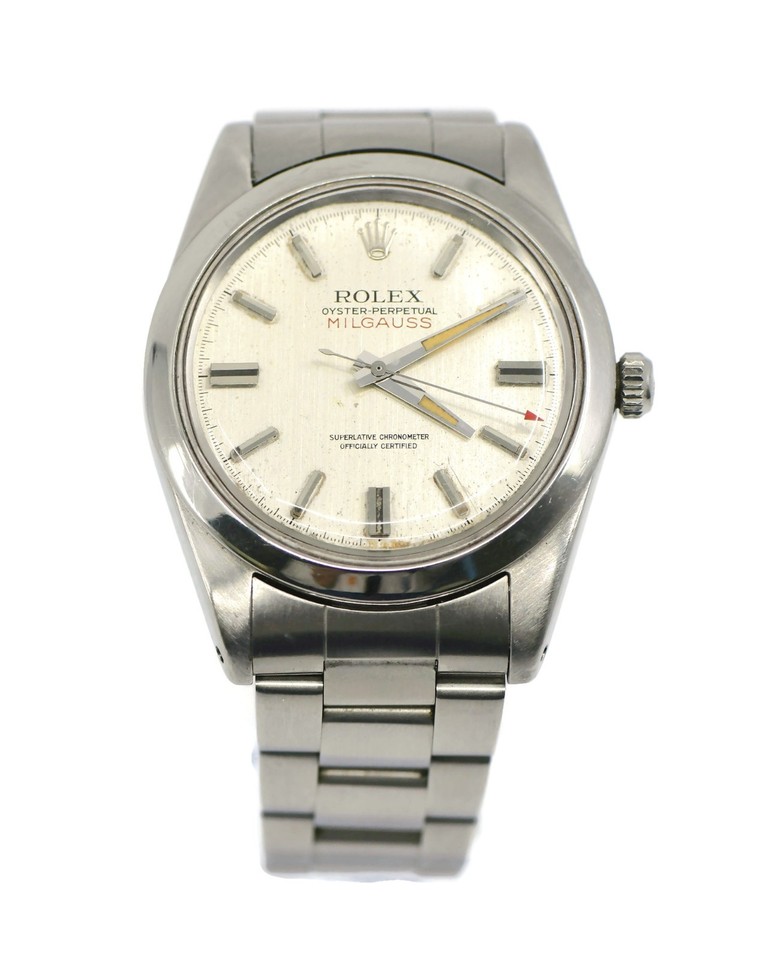
The Milgauss was developed in the mid-1950s, reportedly with input from scientists at CERN, to resist strong magnetic fields. A soft-iron inner cage - a Faraday shield - protects the movement to 1,000 gauss, which gives the watch its name (mille gauss). The reference 1019 arrived in the early 1960s, succeeding the earlier 6541 and 6543.
With a clean, almost tool-like dial, the 1019 was by far the longest-running vintage Milgauss, produced until about 1988. Its most sought-after variant is the lumeless 'CERN dial,' made without radioactive tritium at the laboratory's request.
Notable
- The Milgauss resists magnetism to 1,000 gauss via a soft-iron (Faraday) cage; its name comes from 'mille gauss.' ↗ monochrome-watches.com
- The 1019 launched in the early 1960s, replacing references 6541 and 6543. ↗ monochrome-watches.com
- It was the longest-running vintage Milgauss, made until about 1988. ↗ phillips.com
- The rare lumeless 'CERN dial' omitted tritium at CERN's request. ↗ phillips.com
Sources