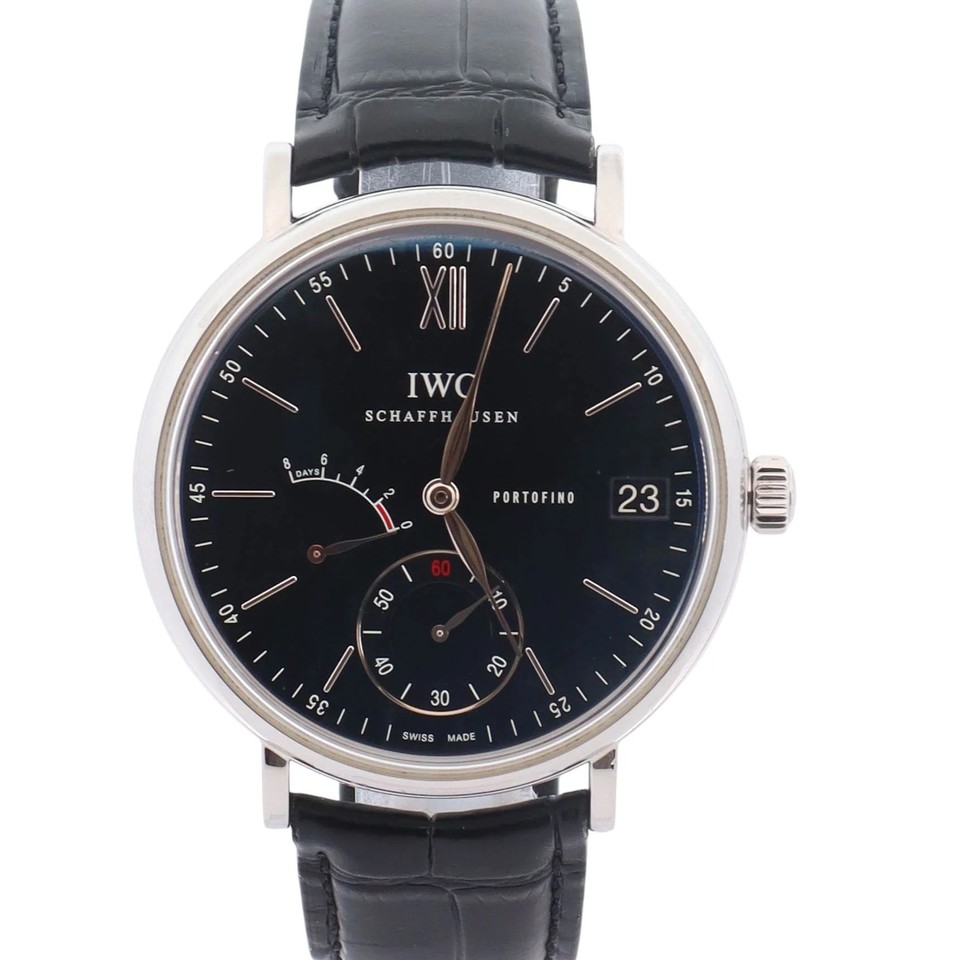
Portugieser Chrono
The Portugieser Chronograph: Valjoux roots, now in-house
Part of IWC's Portugieser family - a line born in 1939 (ref 325) when a Portuguese retailer asked for a wristwatch with marine-chronometer precision - the Portugieser Chronograph debuted in 1998 as reference 3714. A more accessible follow-up to the split-seconds ref 3712, it used a Valjoux 7750-based automatic and quickly became one of IWC's defining designs, with applied Arabic numerals and symmetric sub-dials at 12 and 6 o'clock.
For two decades the 3714 ran on that outsourced 7750 base. In 2020 IWC replaced it with reference 3716, fitting its first in-house chronograph movement, the column-wheel Calibre 69355 (27 jewels, about a 46-hour reserve), while enlarging the case by a negligible 0.1mm to 41mm so the look stayed essentially unchanged. A steel bracelet joined the range that September for the first time.
- The Portugieser Chronograph (ref 3714) launched in 1998 with a Valjoux 7750-based automatic movement, Arabic numerals and twin sub-dials at 12 and 6 o'clock. ↗ rescapement.com
- Its split-seconds sibling, the ref 3712 Rattrapante (a Richard Habring design on a 7750 base), is credited as the first industrialized, mass-produced split-seconds chronograph caliber. ↗ rescapement.com
- In 2020 IWC gave the chronograph its first in-house movement, the automatic column-wheel Calibre 69355 (27 jewels, ~46-hour reserve), in the new reference 3716. ↗ rescapement.com
- The 3716 case grew only 0.1mm (to 41mm) over the 3714, keeping the overall design nearly identical. ↗ rescapement.com
- A stainless-steel bracelet became available for the Portugieser Chronograph for the first time in September 2020. ↗ rescapement.com