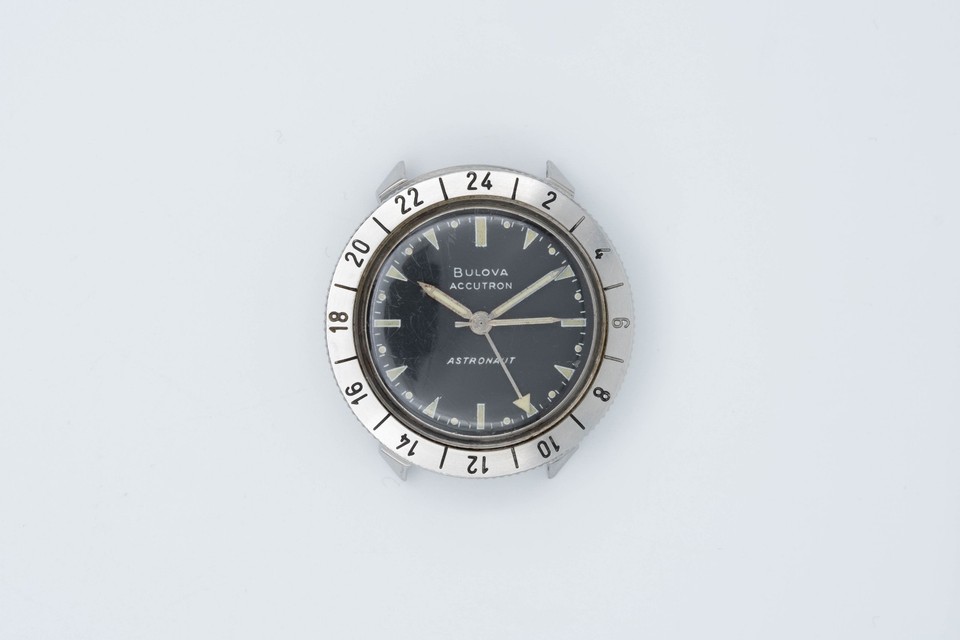
Accutron Astronaut
1962 tuning-fork GMT worn by test pilots and astronauts
The Accutron Astronaut arrived in 1962, built on Bulova's 214 tuning-fork movement. It was Bulova's dual-time-zone Accutron: it added a second, 24-hour hour hand that was read against a rotating 24-hour bezel, so the wearer set the second time zone by turning the bezel rather than setting the hand independently. Its tuning-fork accuracy and lack of a delicate balance wheel made it well suited to high-stress use.
The Astronaut became closely tied to American aerospace. Watch-press accounts report it was issued by the US Air Force to pilots of the A-12 reconnaissance aircraft and the X-15 rocket plane, and that astronaut Gordon Cooper wore an Accutron on the 1963 Mercury-Atlas 9 (Faith 7) mission. These flight and issue claims come from enthusiast sources rather than primary records, so the specifics should be treated with some caution. Accutron reissued the Astronaut in the 2020s, substituting an automatic (Sellita) movement for the original tuning fork.
- The Accutron Astronaut was introduced in 1962 on the Accutron 214 tuning-fork movement. ↗ revolutionwatch.com
- It added a second (24-hour) hour hand read against a rotating 24-hour bezel; the GMT hand could not be set independently, so the second time zone was set by turning the bezel. ↗ revolutionwatch.com
- Watch-press accounts report the US Air Force issued the Astronaut to pilots of the A-12 and X-15 aircraft (enthusiast sourcing, not primary records). ↗ revolutionwatch.com
- Astronaut Gordon Cooper is reported to have worn an Accutron on the 1963 Mercury-Atlas 9 (Faith 7) mission; the flight-worn claim is secondhand and not primary-sourced. ↗ revolutionwatch.com
- Accutron reissued the Astronaut in the 2020s with an automatic Sellita SW330 movement in place of the original tuning fork. ↗ gearpatrol.com